On 15 and 16 June 2026, the LRE Foundation will organise the second edition of the LRE Youth Forum in Wrocław, bringing together young people aged 18-30 from across Europe for two days of exchange, reflection and dialogue on history, remembrance and the challenges shaping Europe today.
The LRE Youth Forum is a space to meet peers from different countries, exchange ideas and discover new perspectives on history. Through open dialogue and shared experiences, it encourages participants to think critically about remembrance and reflect on the role young people can play in keeping it meaningful today. Set in a city shaped by a complex and multicultural past, this edition of the Forum invites participants to explore how history is still visible in everyday life through interactive discussions, workshops and city walks that connect the past with the present.
The programme opens on Monday, 15 June with a welcome session hosted at the Institute of History of the University of Wrocław, followed by a guided historical tour through the city. The tour will focus on Wrocław’s wartime and post-war transformations, highlighting the city’s changing identity and the traces of its German, Polish and Silesian past. It will also explore the presence and coexistence of different religions in the city, reflecting on their role in shaping its cultural and historical heritage. The day will conclude with an official dinner at the Ossolineum, one of the oldest and most important cultural institutions in Poland.
On Tuesday 16 June, participants will take part in an interactive workshop led by Demagog, one of Poland’s leading fact-checking organisations. The workshop will focus on disinformation and manipulation, offering practical tools to recognise misleading narratives, understand how information can be distorted and reflect on the impact of disinformation on democratic societies and contemporary conflicts. Following the workshop, participants will gather for an open exchange of ideas and reflections. The programme will also include a visit to the exhibition at the Depot History Centre, where participants will further explore the post-war history of Wrocław and the experiences of communities shaped by displacement, reconstruction and political change.
Participation in the LRE Youth Forum is free of charge. All programme-related costs are covered by the organisers. Participants are responsible only for arranging and covering their travel to and from Wrocław.
Registration for the LRE Youth Forum is available here and is open until 8 June 2026.
The Youth Forum will take place in parallel with the Public History Summer School organised by the University of Wrocław from 15 to 19 June 2026. The Summer School explores how history functions in the public sphere through lectures, case studies and collaborative projects led by specialists in the field. Participants are also welcome to register for and take part in the Public History Summer School.
The conference brings together museum directors, historians, researchers and memory professionals from across Europe and beyond to discuss how World War II is interpreted, preserved and transmitted today. Its programme addresses major questions for the sector: the mission of military history museums in a time of global instability, the decolonisation of memory in post-communist societies, Holocaust remembrance, humanising narratives of war, and the memorialisation of traumatic events while they are still unfolding. Rémi Praud will contribute to the panel “Humanizing Narratives of World War II” with an introduction on international networking and shared memory of the war.
For the LRE Foundation, this presence in Kyiv is part of a concrete and growing cooperation with the War Museum. Since early 2025, the two organisations have worked together through youth activities connected to WWII remembrance, civic engagement and the transmission of memory in today’s Europe.
Young people from the War Museum have taken part in LRE youth exchanges and LRE Youth Forum, not only as participants, but also as contributors. They have helped lead workshops with other young Europeans, sharing Ukrainian perspectives on war, memory, documentation and resilience. These exchanges have given participants from different countries the opportunity to discuss how history is preserved, how narratives are built, and what it means to speak about war while another war is taking place in Europe.
This cooperation is especially important because the War Museum occupies a unique position. Its primary focus remains the history of the Second World War in Ukraine, while its wider mission also connects this history to Ukraine’s struggle for independence and the ongoing Russian-Ukrainian war. The Museum is therefore not only a place of remembrance, but also an institution working under exceptional circumstances to document, interpret and explain history as it is being violently reshaped.
The LRE Foundation’s participation in the Kyiv conference reflects a simple commitment: to keep Ukrainian colleagues and perspectives fully connected to European conversations on WWII remembrance. This means creating opportunities for exchange, supporting youth dialogue, and exploring future ways to bring the work and perspectives of the War Museum to wider European audiences.
Being in Kyiv this week is therefore not only a gesture of support. It is part of the LRE Foundation’s responsibility as a European remembrance network: to listen, to cooperate, and to ensure that Ukrainian voices are present in the discussions shaping the future of WWII memory in Europe.
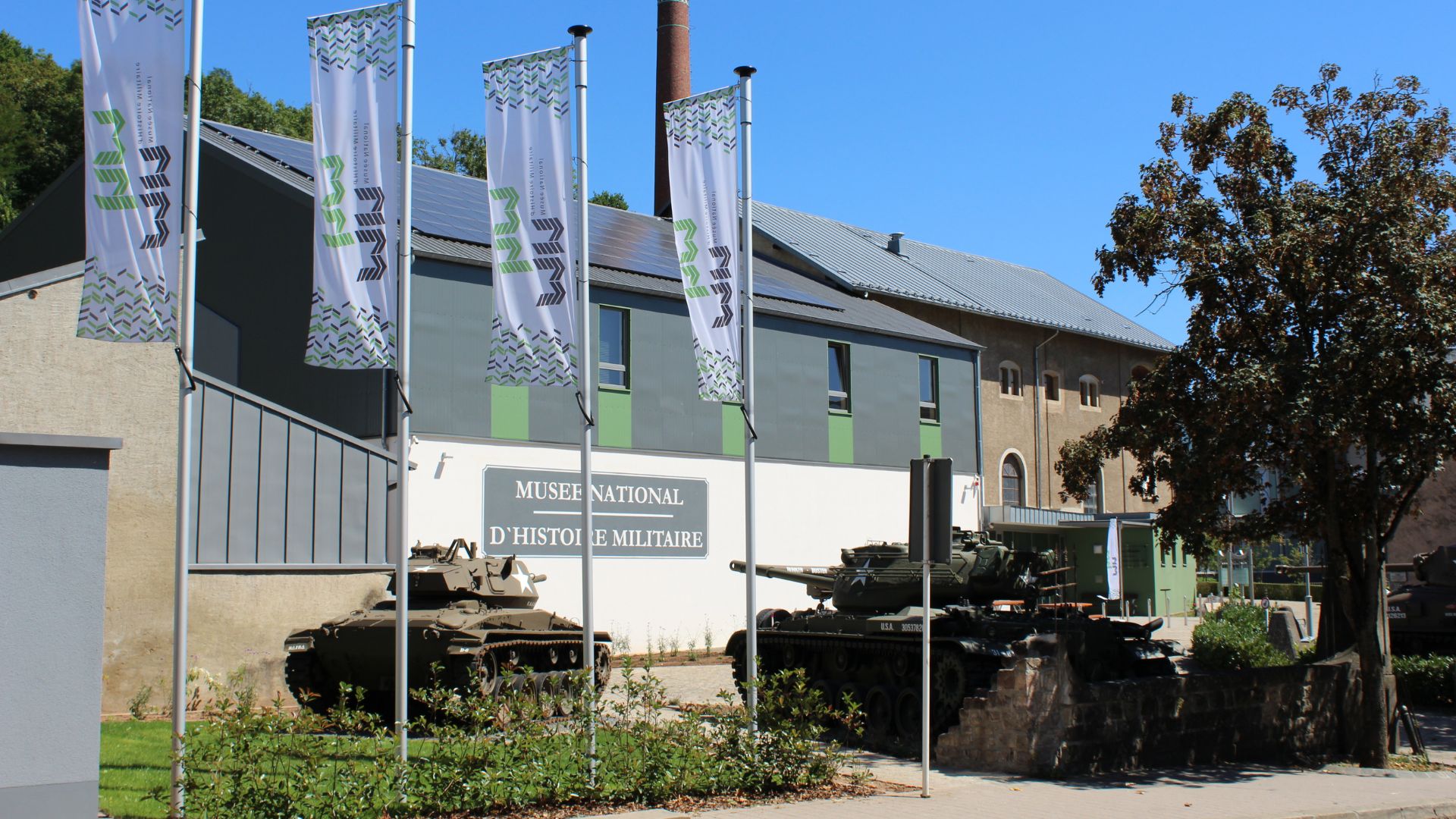
We are pleased to announce the expansion of the LRE Foundation network in Luxembourg with the addition of a new member: The National Museum of Military History. The inclusion of a museum so deeply connected to the history of its region is especially meaningful for our international network, as it allows us to further explore and connect local stories, memories, and experiences that shaped Europe during and after the Second World War.
Located in a region that still bears the scars of the Second World War, the museum was founded in 1982 by a handful of enthusiasts and volunteers. Over the years, it has grown into a key attraction of international renown. With the inevitable disappearance of “first-hand” carriers of memory, there arises a new challenge: finding different means of remembering about the horrors and local histories of war.
Precisely this is the task that the National Museum of Military History intends to pursue as its key objective.
The Museum features large-scale life-size dioramas, thematic exhibits, weaponry, uniforms, vehicles, military gear, original photographs and many personal artifacts to illustrate how the war affected the region in late 1944 and early 1945. These dioramas and personal stories make the history of the Second World War visible and give the visitor a sense of the horrible events that happened during the war.
Not only is the story of the Second World War told, but you will also find more exhibitions that portray the Luxembourg army since 1945, the fate of the Luxembourg soldiers of WWI, WWII and the Korean War from 1950-53, as well as their numerous humanitarian and peacekeeping missions.
“The National Museum of Military History in Diekirch is honored to join the LRE Foundation network. As a museum dedicated to preserving and transmitting the history of the Second World War and military heritage in Luxembourg, we strongly believe in the importance of international cooperation, remembrance, and education,” says Benoît Niederkorn, Director and Curator of the National Museum of Military History and member of the LRE Foundation Historical Advisory Board. “We look forward to developing future collaborations with the LRE Foundation and its partners in order to further promote historical awareness and the preservation of Europe’s shared memory.”
Through this new collaboration with the National Museum of Military History, the LRE Foundation further strengthens its mission of connecting places, stories, and people across Europe. By working together across borders, we continue to foster remembrance, encourage dialogue between generations and countries, and keep the values of freedom, peace, and democracy alive for the future.
On 8 May 2026, a new themed cycling route on the Liberation Route Europe, The Battle at the Heart of the Ardennes, was officially launched in Houffalize, Belgium. Developed by La Maison du Tourisme Coeur de l’Ardenne, the 157-kilometre route retraces the events of the winter of 1944–1945, when the Ardennes became the scene of Hitler’s last major offensive in Western Europe. The project involves the towns of Erezée, Houffalize, La Roche-en-Ardenne, Manhay and Rendeux, linking places that were deeply marked by the Battle of the Bulge.
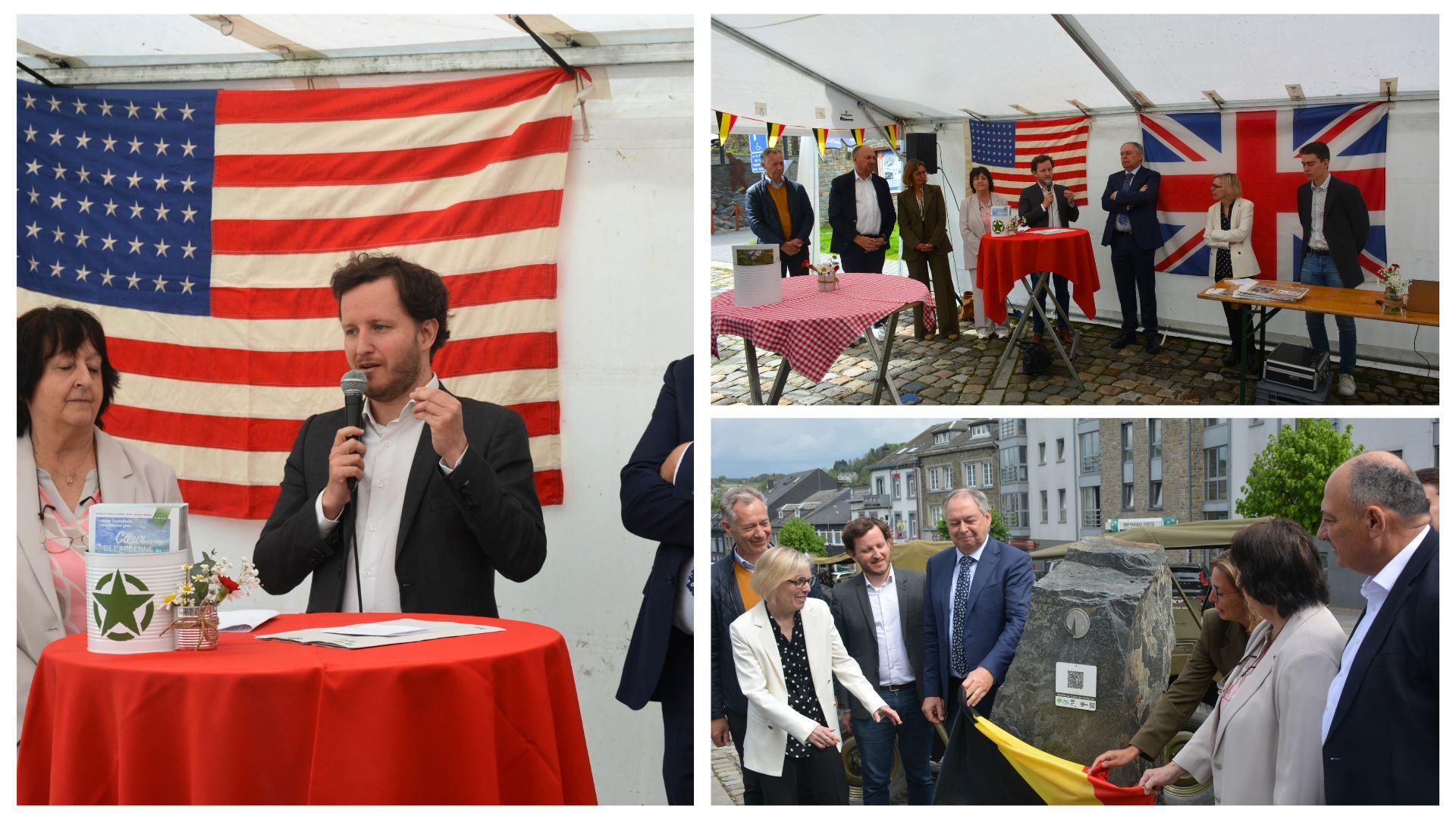
The inauguration took place near the preserved Panther tank in Houffalize, a town that suffered extensive destruction during Allied bombings in January 1945 and endured heavy civilian losses during the Battle of the Bulge. Today, memorials throughout the town, together with the Panther tank, testify to the impact of the battle on the local population. A newVector of Memorywas unveiled during the ceremony, which was attended by Rémi Praud, LREF Managing Director. The launch date was chosen deliberately: exactly 81 years earlier, on 8 May 1945, Germany capitulated, marking the end of the Second World War in Europe.
The cycling route connects towns, memorials and battle sites through winding roads and forest paths across the Ardennes landscape. Along the route, cyclists encounter 30 selected historical sites linked to the Battle of the Bulge and the experiences of civilians and soldiers during the conflict.
In Manhay, cyclists reach one of the strategic crossroads fiercely contested by German and American troops during the winter of 1944–1945, where relics such as a PaK 40 anti-tank cannon remain visible today. The route also passes by the Manhay History 44 Museum, dedicated to the history of the Battle of the Ardennes in the Manhay, Lierneux and Erezée Sectors. Further along the route, La Roche-en-Ardenne bears witness to the destruction caused during the final weeks of 1944. Much of the town was destroyed during the fighting, and today bridges, plaques and monuments commemorate both civilian victims and the resilience of the town. Visitors can discover the La Roche Museum of the Battle of the Ardennes there, one of the largest museums along the route.
Together, these sites create a chronological journey through the Battle of the Bulge, from the surprise German assault to the Allied counteroffensive and eventual victory.
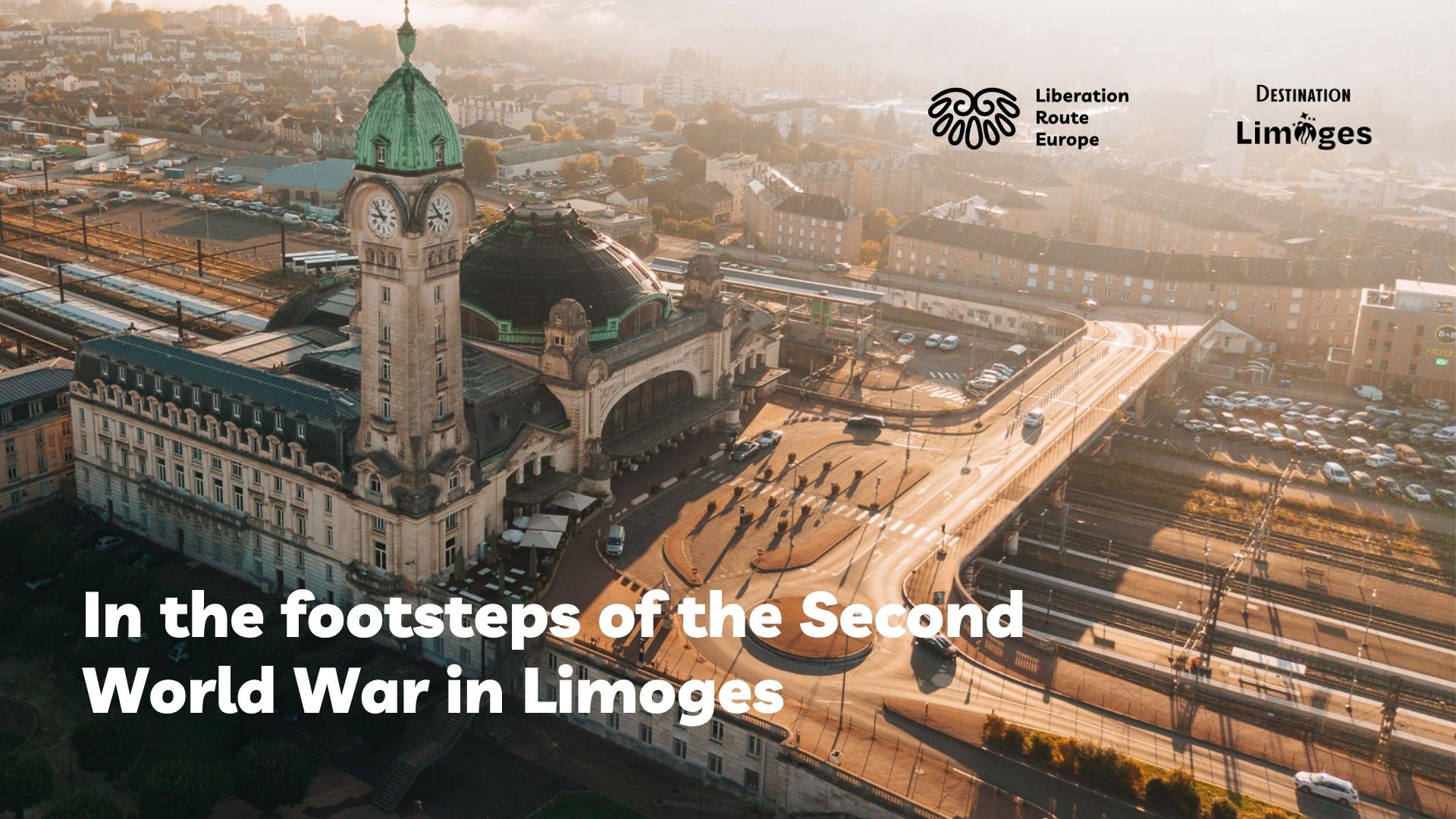
This new route invites visitors to explore the story of the Second World War in Limoges by discovering urban markers and hidden stories in the city’s landscape.
At the onset of the war, Limoges became a place of exile for Belgian parliamentarians and ministers in 1940. Later that year, the city was occupied by German forces once the Vichy Regime was established. Limoges served as the administrative capital of a vast region extending to the demarcation line between Nazi-occupied Northern France and the Vichy Regime South. This region included departments from Dordogne to Cher.
During the war, Limoges became a key hub of resistance in the region, with the city’s liberation on 21 August 1944 as an example. The Resistance, organised under the Forces Françaises de l’Intérieur (FFI), encircled the city, forcing German authorities to negotiate and surrender unconditionally at the Hôtel de la Paix. This negotiation not only avoided civilian casualties but also marked a victory for the FFI.
Exploring the Route: Monuments and Hidden Stories
The 4km hiking route takes visitors to the city centre, discovering eight locations, each revealing a marker of wartime experiences. Following this route, visitors will be able to explore:
Gare des Bénédictins: The train station was a symbolic location that played diverse significant roles during the occupation and liberation of Limoges, from air-raid shelter for the Wehrmacht to a strategic base for the Resistance, which conducted acts of sabotage and hid weapons.
Musée de la Résistance: Located in the former convent of the Sœurs de la Providence, this museum houses a rich collection of artefacts, documents, and testimonies that retrace the history of resistance, occupation, and liberation in Limoges and the surrounding region.
Les Coutures: A working-class neighbourhood under close surveillance due to its political engagement, home to resistance figures like Jeanne Nicot, who sheltered escapees from internment camps.
Lycée Gay-Lussac: A hub of student resistance, where a group of students known as the “17e barreau” engaged in acts of defiance, including stealing uniforms to aid the maquis.
Each location on the route is paired with stories of individuals, from hidden resistance fighters to those who sheltered refugees or sabotaged Nazi operations.
Plan Your Visit
The route starts at the Limoges Town Hall and ends at the Musée de la Résistance. For an overnight stay, visitors are welcome at the Hôtel de la Paix, host of the signing of the unconditional surrender of the German forces in 1944 and still a hotel today.
The geolocalised route is fully accessible via the Liberation Route Europe website and mobile app. Visitors can explore at their own pace, using the app to access detailed information and historical context tied to each location. For those who prefer a self-guided experience, GPX files are available for download, making it easy to navigate the route independently.
The Museum of the Second World War, Gdańsk, in Poland, are participants of the LREF’s projectPreserving the Past, Securing the Future, which provides training and support for stakeholders within the cultural heritage and remembrance tourism sectors to learn about and develop sustainable practices at their sites. The museum was also the host for the project’s second workshop, ’Social Responsibility & Community Engagement in Remembrance’ and Study Visit that took place in April. We spoke to Mateusz Jasik, Deputy Director and Magdalena Jaszcza, Chief Specialist in Programs and Cooperation Department to hear about their experience of PPSF so far and the impact on their own museum.
What motivated the museum to participate in the PPSF project, and what are you hoping to get out of it?
Mateusz: The new management of the Museum of the Second World War in Gdansk, appointed two years ago, has been implementing its goals and strategic vision. The initial priorities included reorganizing the institutional structure, revitalizing main exhibitions, and strengthening cooperation with policymakers and partner institutions. For example, after many years, the museum rejoined the LRE Foundation network. We were also one of the few museums that did not belong to the local coalition of green cultural institutions.
We adopted a different approach to many issues compared to the 2017–2023 period. That is not to say there weren’t interesting initiatives in those years. These included establishing a flower meadow near the museum and implementing filtered drinking water solutions inside the building for employees and visitors. During this time, some of the lighting was also replaced with LEDs and an analysis for solar photovoltaic (PV) panels for the museum was carried out. Other solutions were introduced much earlier, even before the opening in 2017. We organised walking tours and collaborated closely with the local community, aiming to reach the audiences that are often excluded from cultural activities.
In this context, participating in the PPSF program is part of our broader development and analytical efforts, supporting the museum’s long-term strategic growth.
Magdalena: The possibility of hosting the PPSF participants at our museum motivated us to recognize and review sustainable actions taken so far. The result was really uplifting. I think at that stage the most fruitful outcome was that certain sustainable activities had already been self-evident for our teams and have been continued for years now. We exchanged good practices across departments, and our joint discussions were pretty eye-opening. So we made a big step forward in being self-aware and acknowledging where we are in the process of transferring from individual actions of employees or departments to preparing a coherent strategy. The PPSF program is a significant milestone in this journey, while additionally letting us exchange perspectives with foreign partners. What is more, being a host to the second PPSF visit is a strong message to our team that we indeed have much to tell about sustainability!
What have you enjoyed about the project so far?
Mateusz: The PPSF program has, above all, been an opportunity to meet inspiring people—from different countries, with diverse experiences and perspectives. Most importantly, our trainers and our peers already faced many of the challenges we are dealing with today five or ten years ago. This allows us to learn from solutions that have already been tested and implemented.
For example, our museum shop plays a significant role in balancing our budget. Inspired by colleagues from the Juno Beach Centre (Museum in Normandy and PPSF project partner), we would like to introduce a curated selection of souvenirs, slightly more expensive but of higher quality, sourced from local or at least European suppliers. Long-term strategy is one thing, but these smaller, short-term goals are equally important.
The program’s mentoring also lets us notice issues that previously escaped us. For instance, in 2024 the Museum of the Second World War used 475 reams of paper. In 2025, after introducing electronic invoice records, we reduced that number to 442. This is still a significant amount, but we aim to continue decreasing consumption year by year—even as our staff grows due to the development of a new branch on the Westerplatte Peninsula.
As the host of the next PPSF capacity building workshop, what are you most looking forward to in the project?
Mateusz: Above all, we want to continue exploring and being open to programs and initiatives that engage partners from many countries. Only a broad, international perspective can accelerate meaningful change. I am also very keen to ensure that the relationships built within our group are maintained even after the program comes to an end.
Sustainability can be often treated as a buzzword. What does it mean in the context of your museum, and how does it shape your day-to-day work?
Mateusz: One of the most inspiring statements I heard came during a presentation by PPSF project partner Paolo Corti (Fondazione Campus). When he previously tried to promote sustainability, he was often met with a response that there was no ‘time or money’. His response was that sustainability exists precisely to save both: ‘time and money’. This perspective strongly resonates with us, and we would like to start with ourselves—within our museum. We want to ask our colleagues about practices they could potentially give up or change. It is natural that if we have been doing something in the same way for five, ten, or fifteen years, it becomes difficult to abandon those habits. Change is challenging. However, it is much easier to adapt when benefits become visible quickly.
How do you actively involve local communities in Gdańsk in your programmes or exhibitions?
Mateusz: Many residents of Gdańsk and the surrounding region visit the main exhibition at the Museum of the Second World War once, and perhaps return only after several years. With this in mind, we engage them in a variety of ways. First and foremost, we offer temporary exhibitions accompanied by rich public programmes—from workshops and curator-led tours to such activities as the yoga session which took place during our exhibition ‘Fauna. Animals at War and Their Humans’. Yes, this title is intentional: not animals belonging to people, but people dependent on animals.
Although we are, by name, a war museum, our recent temporary exhibitions ‘Forest’ and ‘Fauna’ have been highly sensory, with spectacular scenography, making them ideal settings for concerts and other cultural events. Another important direction involves activities within the permanent exhibitions space. It is playing an increasingly important role as a venue for performances, film screenings (in addition to our dedicated museum cinema), and theatre productions—including collaborations with Miniatura City Theatre for children and young audiences.
These initiatives are aimed at our visitors, but much also happens in direct cooperation with the local community. For example, the museum leads its Museum Theatre Group—an absolute phenomenon. Young participants spend many months preparing a performance which then premieres on our museum stage.
Magdalena: Another possibility of involving the local residents and giving them an insight on how the museum works is the Volunteering Programme. Treating Volunteers as partners and our consultants is essential in this project. They not only support us during events or long-term projects but also can advise us on some of our activities, for example educational projects. Currently we are also developing a Young Museum project, dedicated towards youth and young adults. We are hoping that combining art, education and dialogue will engage young people even more and help to reflect on the significance of history nowadays.
PPSF brings together international partners from different types of WWII remembrance sites and organisations. Have any exchanges with other participants challenged your assumptions or changed your approach to sustainability at your museum?
Mateusz: As I mentioned earlier, sometimes these are very practical, tangible inspirations—for example, working with local suppliers like Juno Beach Centre or looking for allies within institutions, as promoted by Nicole Häusler and María T. Cruz Cortedano (PPSF trainers and project partner, Mascontour). What was most eye-opening for me was how comprehensive this approach is. Previously I treated sustainability as some kind of a green policy. A study visit to Helsinki last year, and ultimately participating in PPSF, allowed me to look at it from a broader perspective. What I like most about the PPSF programme is its positive approach. It is often the case that, for example, architectural accessibility auditors focus on what is wrong. In PPSF, we work in a completely different way—we first look at what is good. That is very motivating!
Magdalena: As Mateusz already mentioned, in Poland sustainability is often reduced to environmental actions. Being in in the process of creating an eco-friendly strategy at our museum, I believe that social sustainability has been at the core of our activities from the very beginning, even before the current building and permanent exhibition opened. Recognising this is very important for us. Moreover, seeing sustainability as a basis for our actions is very refreshing. The wide approach that characterises PPSF definitely broadens our perspective, and also helps us define ideas and values which we can put into action.
PPSF links remembrance with broader issues like climate change and social inequality. How important is this shift in framing for museums today?
Mateusz: In my view, simply telling the story of the past, without offering inspirations for the future, loses its meaning. It is only through reflection on what history can teach us that our work can gain significance. The relationship is quite straightforward. Climate change and social inequality are among the factors that can contribute to conflicts and wars.
The mission of our museum is to serve as a strong warning about the consequences of the Second World War. If we want to caution against war as a tool of politics, we must also address the conditions leading to it.
Magdalena: For Polish museums this might be a new approach, but it is present in our actions more and more often. It could be challenging for some institutions, because sometimes core questions need to be faced about our missions and values: why are we doing it and for whom? At the same time, this approach creates a great possibility for museums to partner in addressing at least some of the challenges of the modern world. Reflecting on the past gives us a chance of deeper understanding and shaping the present.
Do you think social responsibility is relevant or important for museums in the context of remembrance today? What does social responsibility mean for your museum?
Mateusz: Last year, our museum welcomed more than 620,000 visitors. Tens of thousands more attended our temporary exhibitions, participated in workshops, listened to concerts, or visited our cinema. Our team faces significant demands. Despite this, we also strive—within our capacity—to engage NGOs. For example, we work closely with scout groups and veteran organisations.
In the coming months, one of our priorities is to enhance accessibility and inclusivity for people with disabilities, including those with intellectual disabilities. For instance, we plan to introduce plain language in our audio guides. Another new initiative is to open up our activities to the veterans of Polish humanitarian and peacekeeping missions—a large community of individuals who risked their lives in different parts of the world.
What unique role can WWII museums play in strengthening democratic values and social cohesion?
Mateusz: First and foremost, we should draw attention to what led to the Second World War—collusion between totalitarian states: Nazi Germany and the Soviet Union—while also acknowledging the roles of fascist Italy and Japan. The causes include intolerance, hatred, and pervasive propaganda. Beyond warning about where war can lead, today our role should also be to actively combat disinformation, whether it comes from populists or from aggressor states, particularly the Russian Federation. Last year, we hosted the ‘Fake for Real’ exhibition of the House of European History in Brussels. Our education team created workshops for young people, focused on fact-checking. I believe that by running educational programmes for young people from different countries, we can also help prevent xenophobia. At the same time, we must firmly oppose falsehoods, both historical and contemporary. This applies equally to Holocaust deniers and to those who deny crimes such as the Katyń massacre, including representatives of the Russian Federation.
As Władysław Bartoszewski—Auschwitz prisoner, member of the Polish Council to Aid Jews, participant in the Warsaw Uprising, and the patron of the square next to our museum—once said: ‘Truth does not lie in the middle; truth lies where it lies’.
Magdalena: Because of their social influence, museums have the potential for strengthening and uniting communities. At the same time, this might be challenging due to the significant role history plays in shaping modern identity, for instance in Poland, and also the involvement of politics in this process. Regardless of this, stories present in our exhibition have a great educational potential: from their inspiring values and attitudes to the warning signs of tragedies that should never happen again. Hundreds of thousands of our visitors reflect on these stories, and we can create a stronger and engaged society. The key is an attractive, inclusive offer and a narrative for visitors with diverse beliefs and points of view.
What do you hope will be the lasting impact of PPSF on your institution and on the wider WWII remembrance sector?
Mateusz: The impact is already considerable! Joining the PPSF programme was a catalyst for our participation in the green cultural institutions coalition of the Tri-City area (metropolitan area of Gdańsk–Gdynia–Sopot). It is hard not to notice that many processes have accelerated as a result.
Sometimes these are small steps. A colleague from our Marketing and Sales Department purchased reusable bottles for the entire museum team as early as February. At other times, there are larger initiatives such as our redevelopment programme for the museum square. This is a challenging project, as most of our building is located underground, and the square is essentially the structure’s roof. Nevertheless, trees will be planted there. The most important development ahead of us, however, is a more comprehensive way of thinking about sustainability. So far our social policy, green initiatives, and sustainable tourism have often functioned as separate strands. Even one of our ideas—Slow Museum academy—still operates as an independent programme within the Exhibitions Department. There is still much work ahead, but thanks to PPSF we are able to approach many issues more effectively, learning from past mistakes as well as from the experiences of other institutions. Seventeen years ago, when the museum was first established, we had a very different awareness of matters such as visitor neurodiversity. Today, as we develop a new major site at Westerplatte, we already know much more. At the same time, PPSF reminds us to value small successes—for example, introducing walking aids for seniors and lightweight stools, which were previously missing from the museum. Ultimately, what matters most is awareness, progress, and a coherent policy, keeping in mind that this process can be continuously improved.
Janusz Korczak, a Polish and Jewish writer, pedagogue and doctor known for his sacrifice protecting his pupils in the orphanage in the Warsaw ghetto, once said: ‘If you want to change the world, start with yourself’.