

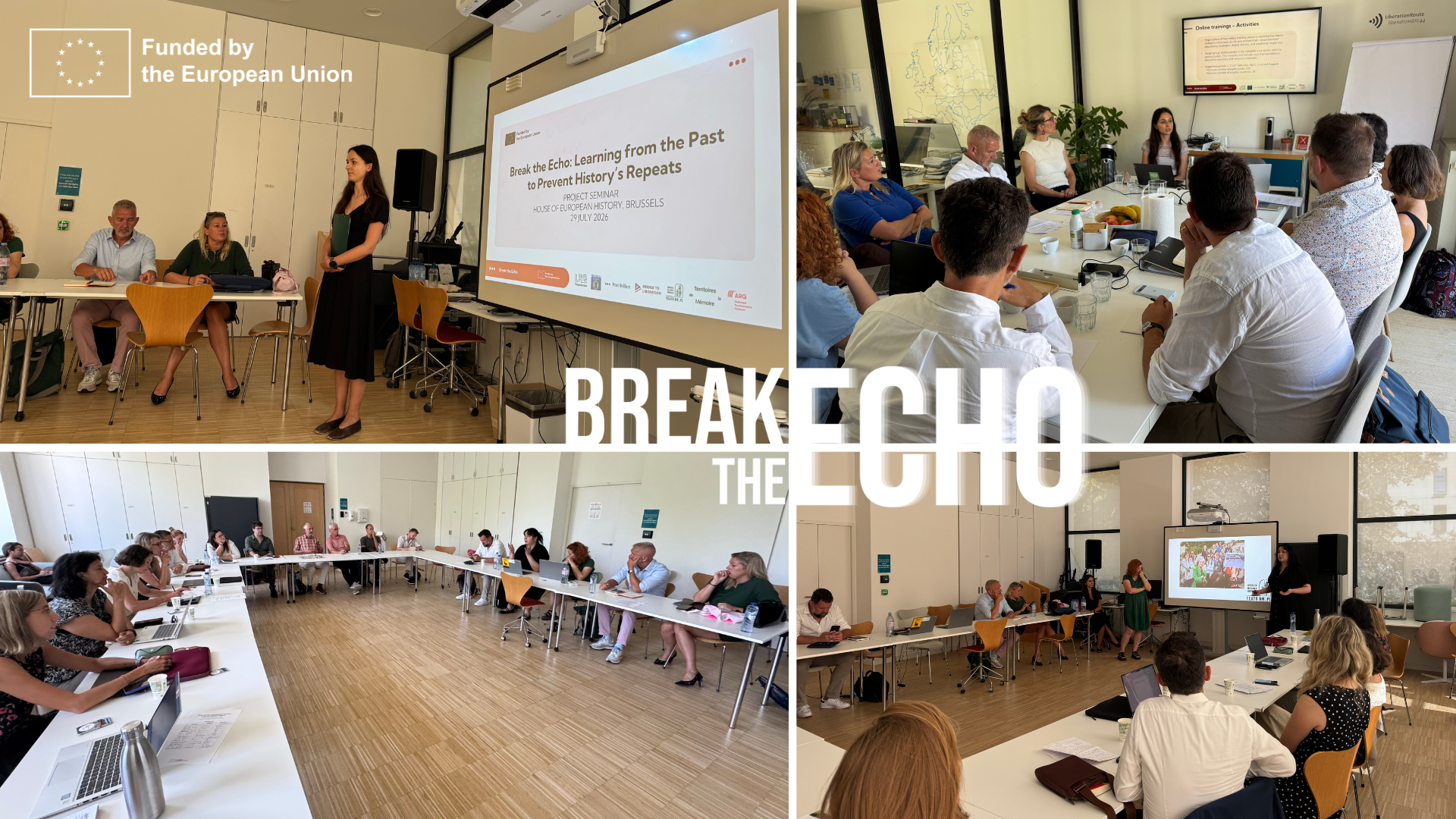
This week, the LRE Foundation and its partners came together in Brussels to kick off the new EU-funded project “Break the Echo”. A seminar at the House of European History the following day served as the opening event for the public programme of the project.
The Break the Echo project is dedicated to addressing Holocaust denial, distortion and antisemitism through education, remembrance, study trips, workshops for professionals and events for young people. Inspired by the idea of breaking the echoes of hatred, intolerance, and historical manipulation, the project promotes learning from the past to shape a better future.
During the seminar on Wednesday, 29 July 2026 at the House of European History in Brussels, project partners, invited expert speakers and guests exchanged best practices in Holocaust education and teaching about Jewish cultural heritage. Museums, memorial sites, research centres and cultural institutions from all over Europe shared their experiences and lessons learned from innovative educational approaches.
The Grodzka Gate – NN Theatre Centre held a workshop on combining local history, personal stories and artistic expression around the Jewish heritage of the city of Lublin in Poland. Véronique Bastian from the Centre Cinqfontaines (Luxembourg) shared her experience in using Holocaust education as a tool to address antisemitism and promote human rights in the organisations’ work with young people. Gabriel Deham from the Jewish Museum of Belgium (Brussels) explained the challenges the museum faces when carrying out its youth educational activities and how the promotion of Jewish heritage and culture can encourage reflection on diversity and inclusion.
“Every Name Matters” is an innovative recording project initiated by Kazerne Dossin (Mechelen), encouraging individual visitors and school groups to record the names of over 25,000 Jewish and Sinti and Roma deportees from Belgium. Larysa Michalska from the Upper Silesian Jews House of Remembrance/Max Kopfstein Association joined the seminar online and presented the context of the Jewish presence in the region and how cooperation with local communities can support the preservation and transmission of memory.
The following discussion provided the opportunity for the group to exchange their personal experiences in working in the field of Holocaust education and how to deal with current challenges and trauma. Many participants noted that stereotypes are still widespread in society and that education on the topic is still very much necessary. After the official programme of the day, seminar participants had the opportunity to visit the House of European History’s permanent collection and the temporary “Postcolonial?” exhibition.
“I am pleased that the Break the Echo project has started with such a meaningful and inspiring meeting. It was a great opportunity to bring together partners and experts, exchange experiences and build a strong foundation for our future cooperation. I believe that our project will bring many valuable results and help us create impactful educational activities that contribute to promoting Holocaust remembrance and addressing contemporary challenges.” says Project Manager Joanna Roman.
Break the Echo is a project funded by the European Commission’s CERV programme. Consortium members are the LRE Foundation (coordinator), partners Post Bellum (Czechia), Bridge to Liberation Foundation (Netherlands), Les Territoires de la Mémoire (Belgium), Province of Lucca (Italy), Grodzka Gate – NN Theatre Centre (Poland) and ARQ Nationaal Psychotrauma Centrum (Netherlands) and associated partner Zikaron Basalon.
Funded by the European Union. Views and opinions expressed are however those of the author(s) only and do not necessarily reflect those of the European Union or European Education and Culture Executive Agency (EACEA). Neither the European Union nor the granting authority can be held responsible for them.


