
New opportunities for LRE members: join the Break the Echo seminar in Brussels and the study trip to Bavaria 

The LRE Foundation is pleased to announce two upcoming opportunities for our members and partners as part of Break the Echo – Learning from the Past to Prevent History’s Repeats, our new European Union-funded project dedicated to strengthening Holocaust education and countering antisemitism, Holocaust distortion, denial and historical manipulation through international cooperation.  

The project kicks off with the Break the Echo Seminar in Brussels on 29 July, followed by an International Study Trip to Bavaria on 12–14 October. 

Registration is now open for both activities.   

Kick-off Seminar in Brussels 
29 July 2026 | House of European History, Brussels 

We invite members and partners to join the Break the Echo Kick-off Seminar, taking place on Wednesday, 29 July 2026, at the House of European History in Brussels

The seminar will bring together project partners and invited experts to exchange best practices in Holocaust education and teaching about Jewish cultural heritage. Through presentations, workshops and discussions, participants will explore innovative educational approaches developed by museums, memorial sites, youth organisations and cultural institutions across Europe. 

The seminar will also offer an excellent opportunity to exchange experiences, strengthen international cooperation, and contribute to the development of the Break the Echo project from its very beginning. It is open to the public upon prior registration, and a free lunch will be provided for all registered participants.  

Please use this registration form to register your interest. 

International Study Trip to Bavaria 
12–14 October 2026 | Germany 

As part of the Break the Echo project, members of our network can also take part in an international study trip to Bavaria. 

Designed for professionals working in remembrance, education and cultural heritage, this intensive three-day programme combines study visits, expert-led workshops and peer-learning activities. Participants will visit key remembrance sites in Munich, Dachau and Nuremberg, examining the origins of National Socialism, the history of the concentration camp system, victims’ experiences and the pursuit of justice in the aftermath of the Second World War. 

The study trip aims to: 

  • deepen understanding of the origins and consequences of Nazism and the Holocaust through direct engagement with key historical sites; 
  • strengthen professional skills in Holocaust education and remembrance practice; 
  • foster international networking and the exchange of methodologies; 
  • support participants in transferring their learning into educational work within their own organisations. 

Further information, including the full programme, will be shared in the coming months. 

Please use this registration form to register your interest. 

Introducing the new “Cammino ’44”

We are delighted to share that “Cammino ’44” – the long-awaited walking route connecting Sant’Anna di Stazzema to Monte Sole – is about to become a reality. This Saturday, 20 June, the first march sets off from the Piazza del Duomo in Pietrasanta, with walkers expected to complete their journey at Monte Sole on 1 July. It is a moment our Italian branch has been working hard for months and we have been looking forward to with great anticipation.

Il Cammino ’44 is a secular memory trail, conceived and developed by LRE Italy, our Italian branch, in close partnership and with the support of the Tuscany and Emilia-Romagna regions. Spanning 180 kilometres through mountain landscapes, historic villages and picturesque scenery across Alta Versilia, the Serchio Valley, the Pistoia mountains and the Bolognese Apennines, it links two of the most significant sites of twentieth-century Italian history. The route is part of the Liberation Route Europe, the European network of hiking and cycling routes dedicated to the history of the Second World War.

All stages of the “Cammino ’44” are well-distributed, with accommodation and refreshment services along the way, and dedicated signposting at each entry and exit point. It can be walked as a continuous journey of around twelve days, or tackled one stage at a time. In this way, the exercise of memory becomes something active, lived and shared: a walk that weaves together slow tourism, culture, nature and history, and brings people into direct contact with stories and places that are part of Italy’s, and Europe’s, collective heritage.

The inaugural ceremony on June 20 will bring together regional leadership from both Tuscany and Emilia-Romagna, reflecting the broad institutional commitment to this project and to the preservation of living memory. Their presence speaks to the significance of what this route represents: not just a walking itinerary, but a shared responsibility to remember the civilian victims of the Second World War.

One of the highlights of the morning will be a conversation with Mario Marsili, one of the very few surviving witnesses of the Sant’Anna di Stazzema massacre. As a symbolic gesture, each walker will receive a scarf to carry along the route and present at both Sant’Anna di Stazzema and Monte Sole – a small but deeply meaningful act, connecting those walking today with the memory of the communities that suffered there in 1944.

We want to address our sincere congratulations to Carlo Puddu, Director of LRE Italy, and Katia Gerunda, Marketing Executive, for their outstanding efforts in turning this vision into reality.

Il Cammino ’44 is now available on its own dedicated website (www.cammino44.it) and on liberationroute.com, where walkers, educators, and all those who wish to engage with this chapter of European history can find everything they need – whether to plan their own journey or to explore the stories from afar.

We warmly invite everyone to join, whether on foot this Saturday or along the way in the days that follow. The route is open to all.

For more information, make sure to follow @Cammino_44 on Instagram

Save the Date: LRE Forum 2027 in Pilsen, 8–11 March

We are delighted to announce that the 11th edition of the LRE Forum will take place from 8 to 11 March 2027 in Pilsen, Czech Republic. Mark your calendars and get ready to join us in Pilsen, a city holding a significant chapter in European WWII history.

The LRE Forum is our annual event, bringing together members, partners, tourism professionals and heritage experts from across Europe and beyond for several days of exchange, discovery and collaboration. Each edition is shaped by its host region, and Pilsen is no exception.

We are working in close partnership with the City of Pilsen, a longstanding member of the LRE Foundation, to build an enriching programme for our network and local institutions. Liberated by American forces in May 1945, the city carries a proud and moving wartime story and we will make sure to integrate it in our programme.

While more details on venues and the full agenda will be shared in the coming months, participants can look forward to:

  • The LRE Member Seminar – Dedicated time for our network to connect, share updates and exchange good practices.
  • The LRE Conference – Expert speakers and open dialogue on WWII memory, heritage and European remembrance.
  • The LRE Gala – An evening to celebrate our community and the work we do together.
  • The LREXPO – A networking space bringing together memorial sites, museums, cities and travel professionals.
  • Site Visits – Curated tours of significant WWII sites in and around Pilsen and Prague offering both well-known landmarks and lesser-told stories from the country.

If you joined us in Gelderland in 2026, we hope to see you again in Pilsen. If this is your first LRE Forum, there is no better moment to experience what brings our network together.

📍 LRE Forum 2027
 📅 8–11 March
 📌 Pilsen, Czech Republic

More information coming soon – in the meantime, save the date and spread the word.

Preserving the Past Securing the Future: Final Workshop on Economic Sustainability in Lucca

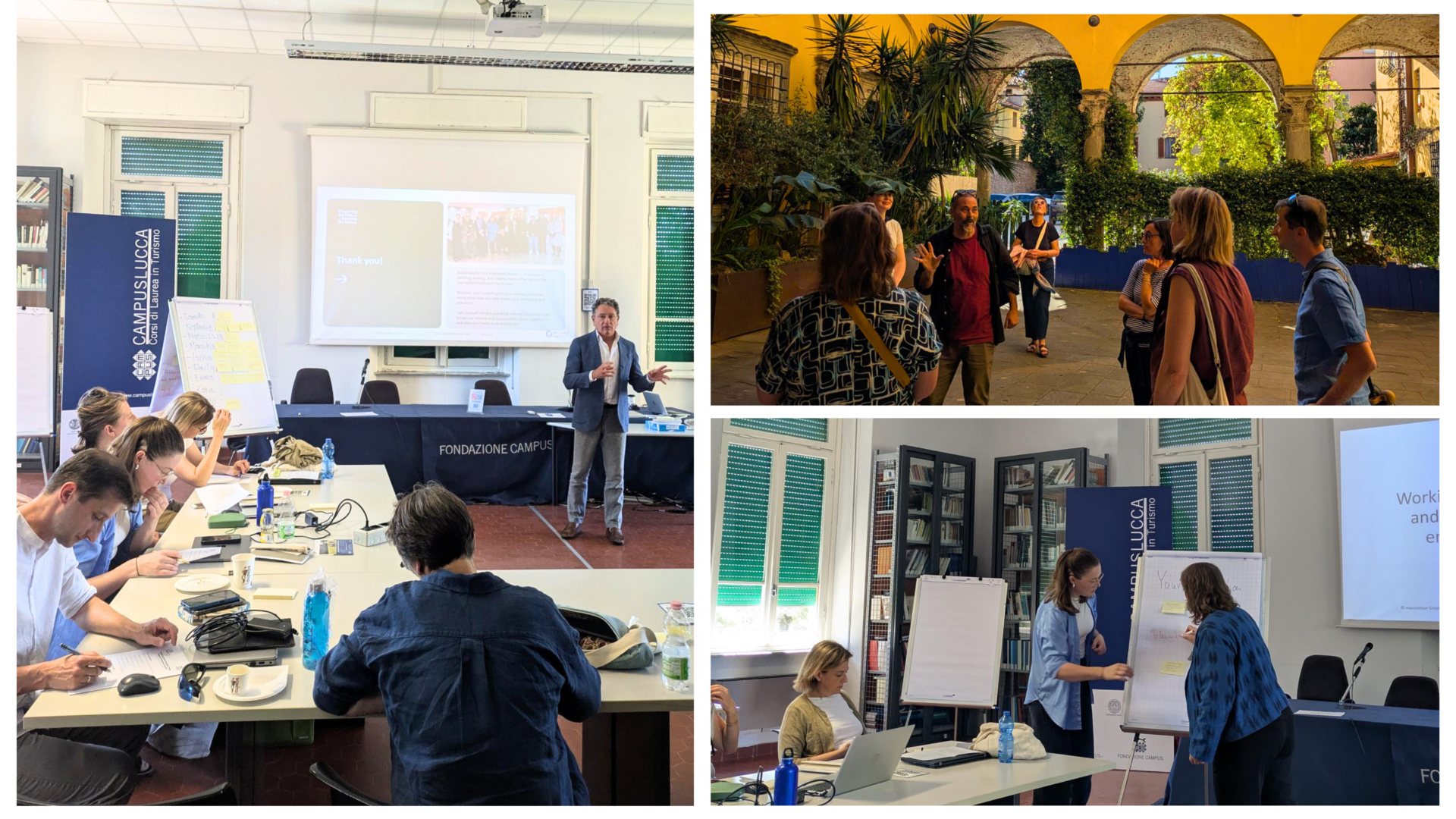
On 11 and 12 June, participants of our Preserving the Past, Securing the Future (PPSF) project gathered in Lucca, Italy, for the programme’s third and final capacity building workshop, ‘Economic Sustainability & Strategic Management of Remembrance Tourism Sites’, hosted by project partner Fondazione Campus

Building on the momentum from Normandy and Gdańsk, this gathering brought heritage professionals from across Europe together one last time to explore how memorial sites can strengthen their financial resilience and management practices, ensuring both their long-term viability and their positive impact on the regions that surround them.

The workshop opened on Thursday morning with a welcome from PPSF project partners followed by an ice breaker exercise and introductions among participants. As with previous sessions, the morning continued with a moment of reflection: participants shared how they had applied the learnings from Workshop 2 on Social Responsibility & Community Engagement in Remembrance Tourism within their own organisations.

The core thematic sessions of the day, moderated by Mascontour, focused on Sustainability and the local economy and Planning, managing and monitoring for sustainability. Through interactive exercises and Q&A discussions, participants explored good practices for embedding economic sustainability into the cultural heritage and WWII memory sector, from strengthening ties with local economies to developing robust management plans that monitor impact over time.

In the late afternoon, the group travelled to Lucca’s historic centre for a walking tour of the city’s famous fortified walls, guided by LRE Italy Director Carlo Puddu, before sharing dinner together.

Friday’s programme turned to the question of funding, with Mascontour introducing tips and resources for successful fundraising in the cultural heritage and WWII memory sector. The final thematic session, The value of our work: Beyond Ticket Sales, brought all three workshops together, as participants reflected on how remembrance work contributes to societal resilience, democratic awareness, community wellbeing and local economic development, and how this impact can be communicated to stakeholders and funders.

“This final workshop brought everything full circle,” says Emme Johnson, Project Manager at the LRE Foundation. “Over the course of three workshops, our participants have built not only practical skills in environmental, social and economic sustainability, but also a strong network of peers they can continue to learn from. It has been wonderful to see how much they have grown together over the course of this programme.”

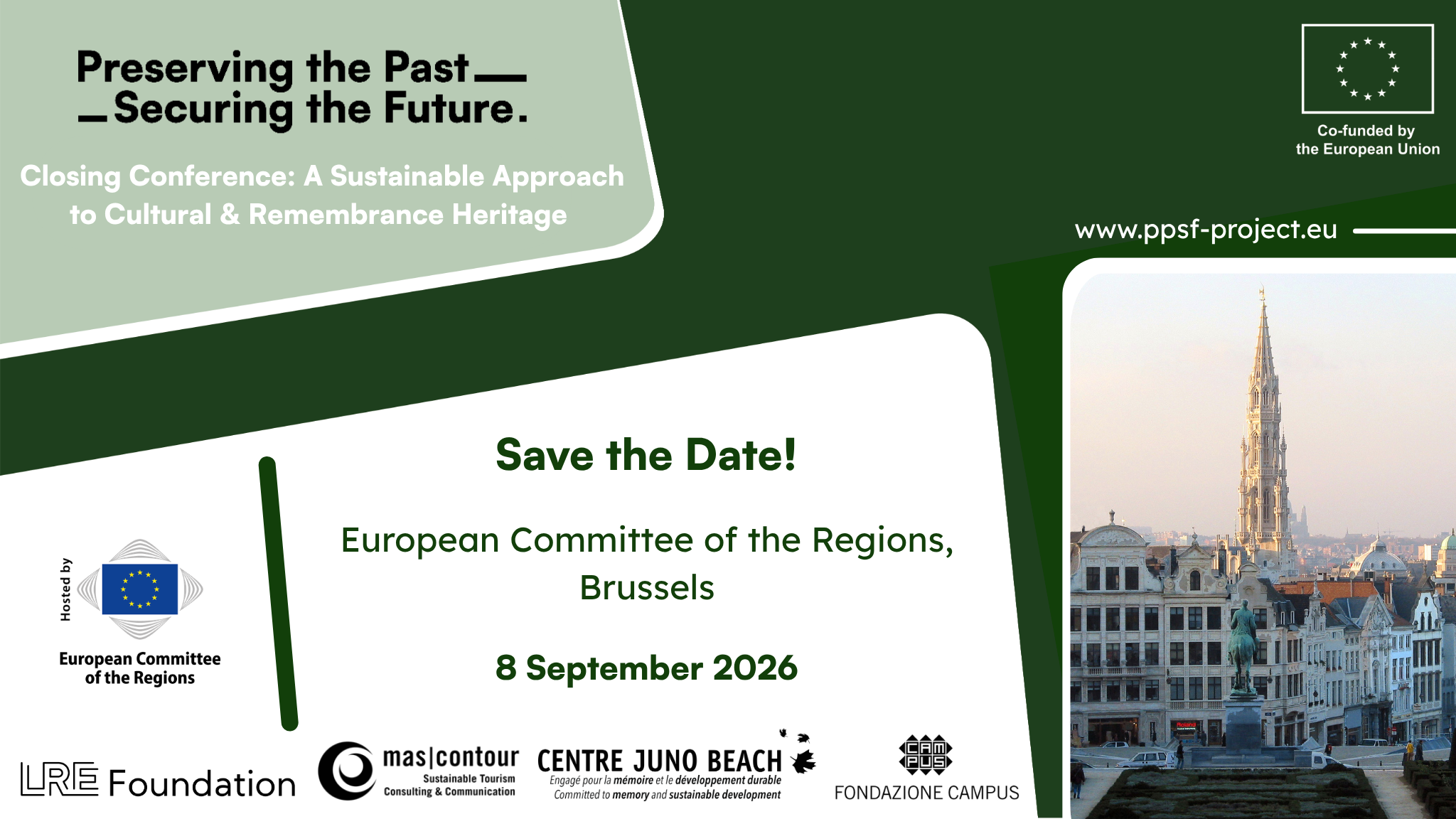
While the Lucca workshop marks the conclusion of the PPSF training programme’s workshop series, the journey doesn’t end here. The project’s findings and outcomes will be shared at a closing conference in Brussels on September 8, bringing together participants, partners, sector stakeholders and members of the public to reflect on the programme’s lessons and discuss the future of sustainable remembrance tourism across Europe. Please make sure to sign up here to ensure entry on the day.

PPSF is a Creative Europe programme co-funded by the European Commission.

Recruitment for the new Youth Ambassadors Network has officially started 

Applications are welcome for the LRE Youth Ambassadors Network, an EU-funded project launched in November last year and brings together young people from all over Europe who want to explore WWII history, connect with others, and take an active role in shaping the future of remembrance. 

Participation is free of charge and open to young people between 15 and 30 years living in the European Union. The network is designed for collaborative learning in a relaxed atmosphere, where participants can learn, exchange ideas, build friendships and reflect on the lessons of the past in relation to the future they want to shape. 

Youth Ambassadors are invited to take part in online and in-person events in different European cities, including workshops, study visits, digital storytelling trainings and opportunities to bring their own ideas into the project’s educational activities. Upcoming in-person highlights are the Youth Forum in Prague, Czechia, in February 2027, the Youth Forum in Bastogne, Belgium, in 2028 and the Youth Remembrance Summit in Gdańsk, Poland, in 2028. 

The Youth Ambassadors Network offers different levels of involvement, depending on participants’ availability and motivation. Young people can take part in a wide range of activities, from occasional online sessions to in-person events and longer-term engagement. At the same time, the network also provides opportunities for participants to take on a more active role in shaping its direction. This includes contributing directly to discussions on planning, priorities and future activities, helping to ensure that the network reflects the needs, ideas and perspectives of its members. 

The LRE Foundation is proud to be the lead partner in this strong consortium of European organisations specialised in youth initiatives, history education and cultural heritage management. The project partners are Post Bellum (Czechia), Max Mannheimer Study Center (Germany), Museum of the Second World War in Gdańsk (Poland), asbl Tourisme, Culture & Patrimoine (Belgium), Interpret Europe (Germany) and Studio Globo (Belgium). 

More information can be found here: www.lre-youth.eu/ambassadors-network/  
You can sign up now via this link: www.lre-youth.eu/sign-up-youth-ambassadors/ 

“Funded by the European Union. Views and opinions expressed are however those of the author(s) only and do not necessarily reflect those of the European Union or the granting authority. Neither the European Union nor the granting authority can be held responsible for them.” 

Join Us for the Closing Conference of Preserving the Past, Securing the Future 

The closing conference of the Preserving the Past, Securing the Future (PPSF) project: A Sustainable Approach to Cultural and Remembrance Heritage, taking place in Brussels, will mark the culmination of two years of collaboration, research, training, and exchange across the WWII remembrance and cultural heritage tourism sector. 

The PPSF project was created to support stakeholders in integrating environmental, social, and economic sustainability practices into their museums, memorials, and remembrance tourism organisations. From the initial needs and market analyses of sustainability in the sector, to the in-person trainings, study visits, peer-learning and mentoring, to the final report on sustainable practices encompassing the experiences and lessons learnt, the project has explored how remembrance sites can remain meaningful, resilient, and accessible for future generations while responding to contemporary sustainability challenges. 

The Closing Conference will bring together sector professionals, policymakers, tourism stakeholders, researchers, and sustainability experts to reflect on the project’s achievements, explore the future of sustainable remembrance practice, and discuss how to ensure the work continues. 

What to Expect 

The half-day conference will showcase the outcomes and impact of the PPSF project, highlighting key achievements, lessons learned, and practical recommendations developed throughout its implementation. 

Participants will gain insight into the project’s main outputs, including: 

  • Presentation of key results and achievements 
  • Insights from pilot actions and collaboration across partners 
  • Reflections on project impact at local and European level 

They will also learn about the project’s final Sustainable Practices Report, bringing together case studies, practical tools, and evidence-based recommendations for heritage practitioners and policymakers that can be applied across different heritage and remembrance contexts. 

Participants will also hear directly from project partners and sector experts during the panel discussion: ‘From Practice to Policy: Lessons Learned and the Path Forward’. This will focus on lessons learned from the project’s pilot activities and transferable good practices for the sector, and how the practical experience gained through PPSF can shape future practice and policy.

The conference is organised by the PPSF project’s partners: LRE Foundation, Mascontour, the Juno Beach Centre, and Fondazione Campus

Why Attend? 

The conference offers a valuable opportunity to: 

  • Reflect on the progress and achievements of the PPSF project. 
  • Explore practical tools and recommendations for sustainable remembrance practice. 
  • Learn from real-world case studies and sector experiences. 
  • Discuss future opportunities and challenges for sustainable cultural heritage tourism. 
  • Connect with a growing network of professionals committed to responsible remembrance and heritage management. 
  • Contribute to ongoing discussions about the long-term stewardship of WWII remembrance sites. 

More than simply concluding a project, the Closing Conference aims to strengthen the momentum created throughout PPSF and support continued collaboration across the sector. By sharing experiences, exchanging ideas, and presenting practical solutions, the event will help ensure that the project’s impact continues well beyond its formal end — empowering heritage professionals and tourism stakeholders to advance sustainable practices for years to come. 

A full programme will be available soon. 

Registration

The event will take place at the European Committee of the Regions in Brussels. As access to the venue is restricted, advance registration is required for all participants.

Please make sure to sign up here to ensure entry on the day.

LRE Foundation welcomes the Lotta Svärd Foundation and the Lotta Museum to its international network 

We are pleased to welcome the Lotta Svärd Foundation and the Lotta Museum to the LREF network, further strengthening our presence in Finland and enriching the diversity of historical perspectives shared across our international community. 

Located on a historic site by the Tuusulanjärvi Lake in Tuusula, the Lotta Museum is a specialist museum of national significance. It is dedicated to preserving and researching the history of the Lotta Svärd organisation and the role of women’s voluntary work in Finnish society.  

The Lotta Svärd was a women’s voluntary organisation supporting national defence efforts that operated from 1921 to 1944. At its peak, it involved over 220,000 women and girls. During wartime, its members worked in nursing, communications, logistics, food supply, equipment maintenance and many other essential roles, both on the home front and near the frontlines. Whilst the Lottas generally did not take part in armed combat, in the summer of 1944 they formed the 14th Searchlight Battery Division for the 1st Anti-Aircraft Regiment in order to ease the shortage of men. However, this was the only women’s military unit that was active and ready for combat during the years the Lotta Organisation was active. The Lotta’s experiences form an important part of Finland’s wartime history and contribute to a broader and more nuanced understanding of the Second World War in Europe, including perspectives that are still too often overlooked. 

With several members already in Finland, the addition of the Lotta Museum brings an especially valuable perspective to the network by highlighting women’s experiences and contributions during WWII. This new membership reflects the LRE Foundation’s ongoing commitment to a multiperspective approach to history, ensuring that lesser-known stories from across Europe become part of a shared and more inclusive narrative of the war. 

“We are very pleased that the Lotta Museum has joined the LREF cooperation network. In this way, the work of Finnish women and the members of the LottaSvärd organisation will receive the international visibility it deserves. I warmly welcome everyone to visit the Lotta Museum.” says Saija Ylitalo, Museum Director. 

Rémi Praud, Managing Director of the LRE Foundation, also welcomed the new partnership: 

“The stories preserved and shared by the Lotta Museum are an essential contribution to our understanding of the Second World War in Europe. Learning more about the experiences of Finnish women and the members of the Lotta Svärd organisation has been deeply enriching for our network. This collaboration is an important step toward broadening the perspectives represented within European remembrance, and we are looking forward to developing future projects together.” 

The new partnership marks the beginning of a broader collaboration between LREF and the Lotta Museum, opening opportunities for future international projects, exchanges and educational initiatives that connect Finnish wartime experiences to the wider European history of WWII.