Members showcase Liberation Route Europe in Finland at Matka Travel Fair 

From 15 to 18 January, LRE Foundation members in Finland represented Liberation Route Europe at the international Matka Travel Fair in Helsinki. The fair is Northern Europe’s largest travel industry event, where travel enthusiasts and professionals from nearly 70 countries come together. This year’s event welcomed a total of 56,400 visitors and exhibitors and offered a great opportunity to introduce the Liberation Route Europe network to a broad audience and highlight our members in Finland

Since 2023, when LREF welcomed our first Finnish member, Muisti Centre of War and Peace, the network has steadily expanded in Finland. This year’s exhibition stand brought together World War Two history sites from across Eastern Finland, with four of the network’s five Finnish members participating in the fair. Representing the network were the Muisti Centre of War and Peace, the Ilomantsi Battlegrounds Trail, the Kuhmo Winter War Museum, and the Salpa Line Museum

This year also marked the first occasion where Eastern Finland’s military history destinations were presented collectively as a unified network. These sites are connected by the Via Karelia tourist route, which follows Finland’s eastern border.

For Finland, the Second World War encompassed three separate conflicts, shaped by the country’s difficult position between German and Soviet strategic interests. The participating sites shed light on this complex history and the lasting impact of the war on the region.

We are pleased to be bringing this important WWII history into the international narrative, and representation at events such as Matka Travel Fair is an essential part of highlighting this work to the international travel industry. 

LRE Conference 2026 to Address the Future of World War II Remembrance 

The LRE Conference 2026, titled “Beyond the 80th Anniversary: The Future of World War II Remembrance”, will take place on 10 March 2026 at the Open Air Museum in Arnhem, the Netherlands, as part of the 10th edition of the LRE Forum. 

As the 80th anniversary commemorations of the Second World War conclude, the conference will focus on how remembrance can remain meaningful in a time marked by the loss of eyewitnesses, growing historical distortion, digital transformation and changing political and societal challenges. Open to everyone, the event will bring together international experts from the fields of history, education, cultural heritage and remembrance policy to reflect on the future of WWII memory in Europe and beyond. 

The opening plenary session, Safeguarding WWII Memory in a Changing World, will feature James D. Bindenagel, former United States Ambassador to Germany; Jurmet Huitema-de Waal, education expert at the Anne Frank House; and Rafał Rogulski, Director of the European Network Remembrance and Solidarity. Together, they will examine the political, educational and social responsibilities of remembrance in the decades ahead in shaping resilient and inclusive societies. 

In the afternoon, participants will engage in parallel roundtable discussions addressing some of the most pressing challenges facing memory institutions today. These include the future of remembrance tourism in the context of climate change, innovative ways of engaging younger generations through digital tools and education, the importance of international research and multi-perspective historical narratives, and the development of inclusive and contemporary commemorative practices. 

Speakers contributing to the roundtables include Rebecca Armstrong of The Travel FoundationBen de Vries of Military Heritage, Cultural Heritage Agency, The Netherlands, Ave Paulus of ICOMOS EstoniaVictoria Grace Richardson-Walden from the University of Sussex, Sandra Camarda of the Luxembourg Centre for Contemporary and Digital History, Marlene Wöckinger of the Mauthausen concentration camp memorialJoanna Wojdon from the University of Wrocław, Poland Hinke Piersma of NIOD Institute for War, Holocaust and Genocide StudiesPeter Johnson of the Imperial War MuseumsJana Wohlmuth Markupová from Charles University, Marta Berecka of the Auschwitz-Birkenau State MuseumLaurent Bellini from the City of Paris and Nienke Majoor of the Dutch National Committee for 4 and 5 May, among others. 

The conference is part of the wider LRE Forum 2026, the LRE Foundation’s annual event, which will take place from 9 to 12 March in Arnhem and Nijmegen in collaboration with the Cities of Arnhem and Nijmegen and the Province of Gelderland. Marking its tenth anniversary, the forum will feature professional exchanges, site visits, exhibitions and networking activities for remembrance and heritage professionals from across Europe. 

By looking beyond milestone anniversaries, the LRE Conference 2026 aims to strengthen international cooperation and ensure that the memory of World War II continues to inform democratic values, historical awareness and civic responsibility for future generations. Join us in Arnhem to take part in this shared reflection and help shape the future of remembrance. 

More information and registrationhttps://www.lre-foundation.org/conference-2026/  

The LRE Foundation welcomes the Greek Municipality of Ioannina as its new member. 

The LRE Foundation is strengthening its presence in Greece by welcoming the Municipality of Ioannina into its international network. This addition marks a step towards stronger collaboration between Greece and other European countries on issues of WWII remembrance. It also enhances the Foundation’s multiperspective approach to history, shedding light on Europe’s wartime past through different angles, promoting mutual understanding at a transnational level and across communities. 

Ioannina is a city built on the west bank of Lake Pamvotis, a naturally fortified position. Its history goes back to the Hellenistic period, and it has been the capital city of the Region of Epirus in northwestern Greece since the 10th century. During the Second World War, Ioannina became the headquarters of the Greek Army that defended against the Italian attack in 1940. In April 1941, it was intensively bombed by the Luftwaffe (German Air Force).  In 1944, during the Axis occupation, the Jewish community in Ioannina was rounded up by the German forces and sent to the Auschwitz-Birkenau concentration and extermination camp, while hundreds of civilians were massacred. 

The Mayor of Ioannina, Mr Thomas K. Begkas, highlights the need to keep the memory of the war victims alive, so that the horror and the bigotry of the war will never be forgotten and repeated 

‘We are urging for a society based on mutual respect and peace”, he says. “We need to stay united against all forms of hatred and fanaticism. Historical memory is not a luxury; it is a duty.’ 

Managing Director of LRE Foundation, Rémi Praud, notes: ‘By welcoming the Municipality of Ioannina into our network, we aim to acknowledge and widely share the wartime experiences endured in Greece and to connect them with the history of the Second World War in Europe. We hope to strengthen these historical links and develop meaningful partnerships.’ 

Ioannina is one of many Greek regions deeply affected by the Nazi Occupation. The Municipality’s efforts to preserve this memory resonate across the LREF network, and we aim to support exchanges that help younger generations understand this legacy and promote mutual respect. 

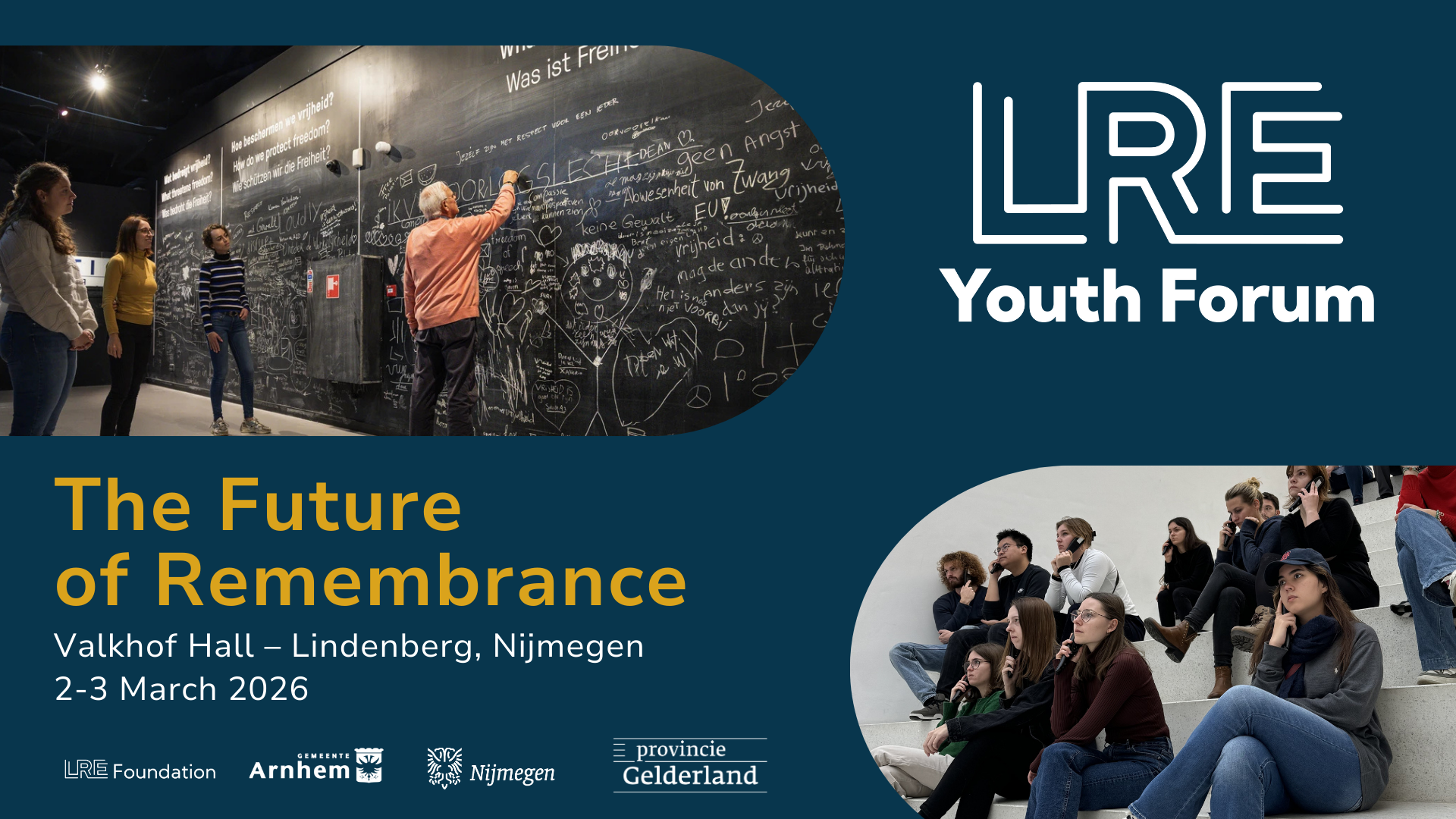
LRE Youth Forum invites Young Europeans to Nijmegen to Reflect on the Future of Remembrance 

One week ahead of the LRE Forum 2026, the LRE Foundation will launch the first edition of the LRE Youth Forum: The Future of Remembrance, an international gathering dedicated to young Europeans aged 18–25.

Taking place on 2 and 3 March 2026 in Nijmegen, the LRE Youth Forum invites young people from The Netherlands and across Europe to come together, exchange perspectives, and engage critically with history, memory, and contemporary challenges. Set in a city deeply shaped by the Second World War, the forum creates a space for dialogue between past and present, encouraging participants to reflect on how remembrance is discussed, questioned, and reinterpreted across generations.

Over two days, the programme explores how the legacies of war and violence continue to shape societies today. Through plenary discussions, workshops, and visits to historical sites, participants are invited to engage with memory not as something fixed, but as a lived and evolving process.

The forum opens on Monday 2 March with a plenary session at Lindenberg’s Valkhof Hall. This is followed by two parallel sessions: a discussion on documenting the war in Ukraine and its connection to Ukrainian Second World War history, and a workshop on The Future of Remembrance, led by Scuola di Pace di Monte Sole. Participants will take part in both sessions, rotating between them throughout the day.

On Tuesday 3 March, the programme continues with a workshop focused on creating historical content, offering young participants the opportunity to engage directly with Second World War history through the curation of personal stories. The morning concludes with a collective reflection on the future of remembrance, during which participants develop shared conclusions that will be presented at the LRE Forum 2026. In the afternoon, the programme includes a visit to the WWII Information Centre, a guided historical tour of Nijmegen, and a visit to the Valkhof bunker.

Organised by the LRE Foundation, the Youth Forum is part of a wider effort to connect people and organisations working on the memory and meaning of the Second World War across Europe. In particular, the Youth Forum offers young participants the chance to meet peers from different countries, exchange ideas, and reflect together on why history still matters today and how it can inform engagement in the present.

The LRE Youth Forum takes place one week ahead of the LRE Forum 2026, the LRE Foundation’s annual international gathering. This year, the four-day event will be held in Gelderland in cooperation with the Cities of Arnhem and Nijmegen and the Province of Gelderland, bringing together professionals from institutions across Europe working to research, preserve, and transmit the memory and lessons of the Second World War.

Registration for the LRE Youth Forum is now open.

If you are aged 18–25 and want to join – or know someone who might be – early registration is recommended, as places are limited. Please sign up before February 24th.
More information and sign-up here.

LRE Foundation Signs First Memorandum of Understanding in Albania with the Region of Tirana

The LRE Foundation is honoured to announce the formalisation of a Memorandum of Understanding with the Council of the Region of Tirana. This agreement marks our first formal cooperation with a regional authority within the Republic of Albania. 

The Memorandum of Understanding formalises a shared commitment between the LRE Foundation and the Region of Tirana to work together on initiatives linked to the history and memory of the Second World War. Through this collaboration, we aim to strengthen awareness, education, and public engagement around WWII-related topics, while further anchoring local histories within a broader European narrative of war, resistance, and liberation. 

The Region of Tirana stands as a cornerstone of Albania’s administrative landscape, comprising the municipalities of Tirana, Kavajë, Kamëz, Vorë, and Rrogozhinë. With a population approaching one million inhabitants, the region has consistently exercised a central influence on the nation’s political, social, and historical evolution. Its prominence was particularly pronounced throughout the tumultuous period of the Second World War, when Tirana became a key site of occupation, resistance, and eventual liberation. The region’s rich tapestry of historical events underscores its relevance to both national and European historical narratives. 

The Second World War and the Liberation of Tirana 

The Second World War marked a decisive chapter in the annals of Tirana’s modern history. Commencing in April 1939, the city experienced a period of occupation by Fascist Italian forces, which persisted until September 1943. During these years, Tirana experienced significant urban and architectural transformations shaped by Italian imperial planning, elements of which remain visibly integrated into the city’s contemporary urban fabric. 

In September 1943, following significant political shifts within Italy, German forces advanced to occupy Albanian territory. Tirana rapidly consolidated its position as a central command hub for the nascent Albanian resistance movement, where indigenous partisan units spearheaded an impactful anti-fascist struggle. The year 1944 witnessed a marked intensification of these resistance activities, correlating with the shift in the global balance of the war. This escalation culminated in the Battle for Tirana in November 1944, a nineteen-day urban conflict that ended with the liberation of the capital on 17 November 1944. 

Albania holds a distinctive position in the history of the Balkans, having achieved liberation without direct military intervention by major external powers. The complete withdrawal of German forces was accomplished by the end of November 1944, a historical event commemorated annually on 29 November as Albania’s National Liberation Day. 

A Shared Commitment to the Preservation of European Memory  

Mr. Aldrin Dalipi, Chairman of the Regional Council of Tirana, articulated with clarity the strategic imperative and enduring significance of this pivotal agreement. He asserted, “This collective affirmation of unity, a principled stand against fascism and all forms of authoritarianism, constitutes an indispensable message, a legacy bequeathed from the generation that triumphed through the Second World War to all succeeding generations. It is, therefore, our responsibility to vigilantly safeguard this historical patrimony from the corrosive effects of temporal forgetfulness, ensuring its preservation, dynamic revitalization, and sustained prominence within the European narrative. The Regional Council of Tirana views this Memorandum of Understanding with the LRE Foundation as a foundational instrument, a strategic advancement towards achieving membership within this esteemed European initiative. Our overarching objective is to establish the requisite institutional and experiential frameworks, thereby empowering citizens, scholars, and cultural practitioners who possess a deep affinity for history, regional identity, and cultural heritage to engage with and valorise the multifaceted resources inherent to our Region. Through a synergistic collaboration with the LREF, and by strategically leveraging the instruments provided by the Liberation Route Europe, we are committed to integrating our territorial assets and rich historical tapestry into an overarching, compelling cultural and touristic experience that resonates across the continent“.  

Rémi Praud, Managing Director of the LRE Foundation, further emphasised the importance of this Memorandum of Understanding as a step forward in long-term cooperation. He stated, “This Memorandum of Understanding with the Region of Tirana is an important milestone for the LRE Foundation and a meaningful first agreement in Albania. It reflects a shared interest in working together on remembrance and education, while recognising the strong place Tirana already holds within the history of Europe during the Second World War. Through this partnership, we can further develop existing connections and ensure these histories remain accessible and relevant for future generations.”