

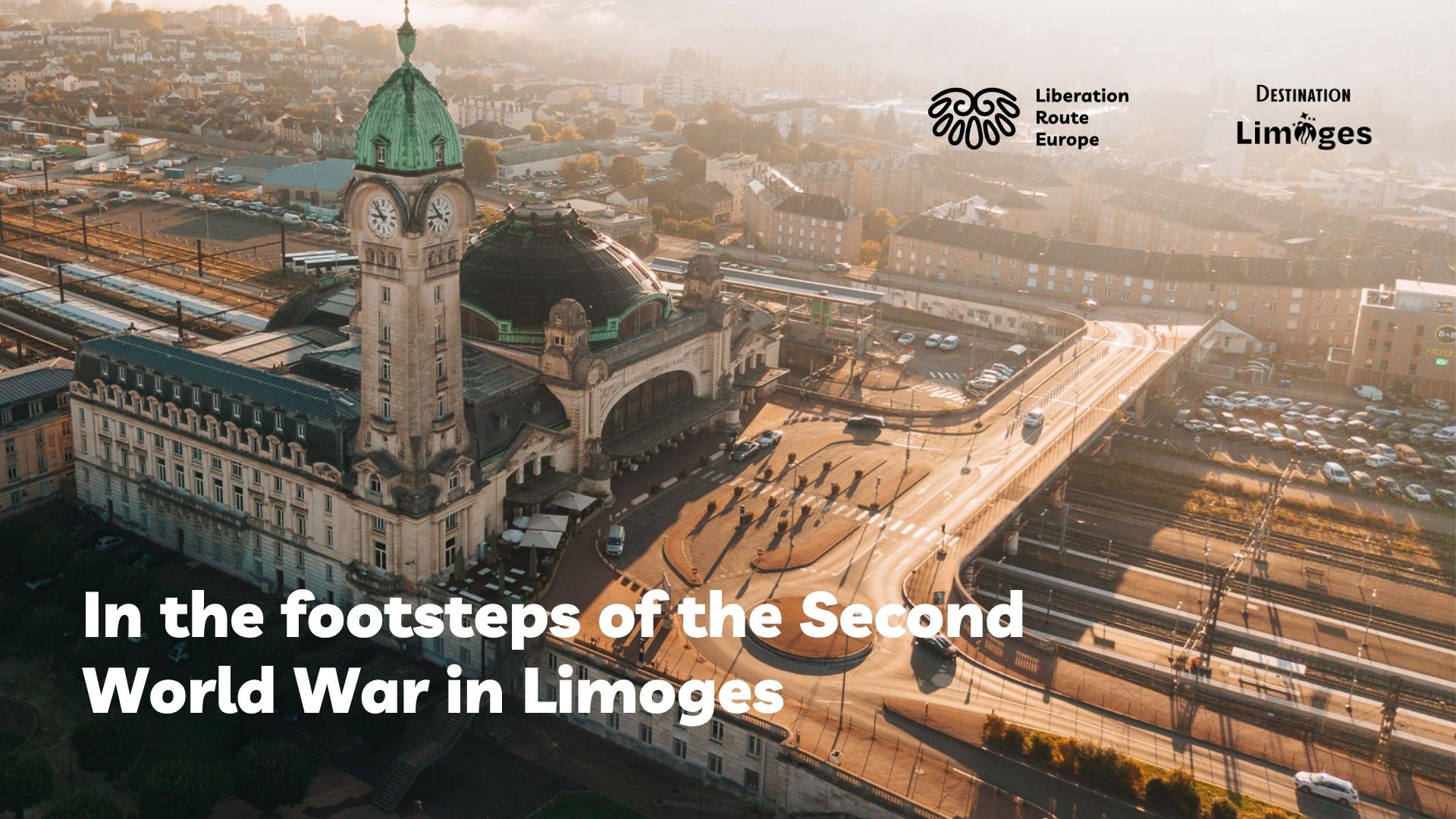
In partnership with Destination Limoges and Musées Limoges, we launched a new themed route, In the Footsteps of the Second World War in Limoges. This latest addition to the Liberation Route Europe invites visitors to explore the history of Limoges, the capital of Haute-Vienne, France.
Shedding light on Limoges’ WWII history
This new route invites visitors to explore the story of the Second World War in Limoges by discovering urban markers and hidden stories in the city’s landscape.
At the onset of the war, Limoges became a place of exile for Belgian parliamentarians and ministers in 1940. Later that year, the city was occupied by German forces once the Vichy Regime was established. Limoges served as the administrative capital of a vast region extending to the demarcation line between Nazi-occupied Northern France and the Vichy Regime South. This region included departments from Dordogne to Cher.
During the war, Limoges became a key hub of resistance in the region, with the city’s liberation on 21 August 1944 as an example. The Resistance, organised under the Forces Françaises de l’Intérieur (FFI), encircled the city, forcing German authorities to negotiate and surrender unconditionally at the Hôtel de la Paix. This negotiation not only avoided civilian casualties but also marked a victory for the FFI.
Exploring the Route: Monuments and Hidden Stories
The 4km hiking route takes visitors to the city centre, discovering eight locations, each revealing a marker of wartime experiences. Following this route, visitors will be able to explore:
- Gare des Bénédictins: The train station was a symbolic location that played diverse significant roles during the occupation and liberation of Limoges, from air-raid shelter for the Wehrmacht to a strategic base for the Resistance, which conducted acts of sabotage and hid weapons.
- Musée de la Résistance: Located in the former convent of the Sœurs de la Providence, this museum houses a rich collection of artefacts, documents, and testimonies that retrace the history of resistance, occupation, and liberation in Limoges and the surrounding region.
- Les Coutures: A working-class neighbourhood under close surveillance due to its political engagement, home to resistance figures like Jeanne Nicot, who sheltered escapees from internment camps.
- Lycée Gay-Lussac: A hub of student resistance, where a group of students known as the “17e barreau” engaged in acts of defiance, including stealing uniforms to aid the maquis.
Each location on the route is paired with stories of individuals, from hidden resistance fighters to those who sheltered refugees or sabotaged Nazi operations.
Plan Your Visit
The route starts at the Limoges Town Hall and ends at the Musée de la Résistance. For an overnight stay, visitors are welcome at the Hôtel de la Paix, host of the signing of the unconditional surrender of the German forces in 1944 and still a hotel today.
The geolocalised route is fully accessible via the Liberation Route Europe website and mobile app. Visitors can explore at their own pace, using the app to access detailed information and historical context tied to each location. For those who prefer a self-guided experience, GPX files are available for download, making it easy to navigate the route independently.

