

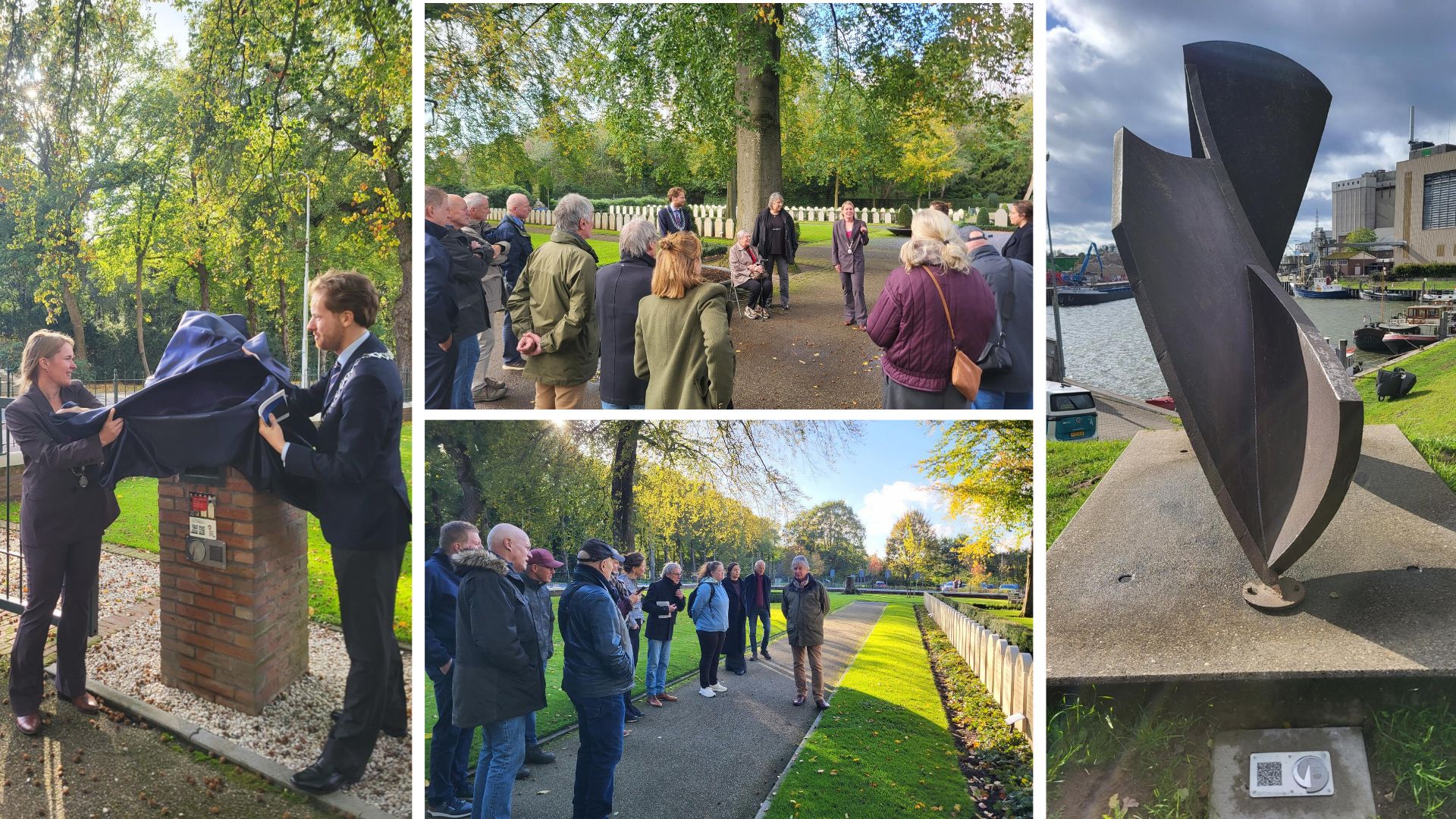
This Thursday 22 October, at the entrance of the Cemetery of Honor Grebbeberg, the 3km walking route The battle of the Grebbeberg: the beginning of the Second World War in the Netherlands and the 18km cycling route Rhenen and Wageningen: Beginning and end of the Second World War in the Netherlands have been officially launched as part of the Liberation Route Europe. The development of the routes was made possible by a collaboration between Oorlogsgraven Stichting (War Graves Foundation), Stichting De Greb and LRE Foundation.
Because of their strategic position on the Nederrijn (Lower Rhine) and the Grebbeberg, both Rhenen and Wageningen became the central theatre of war at the start and at the end of WWII. This context forms the centrepiece of both routes, which cover both the military and civilian perspectives. From the Battle of the Grebbeberg in May 1940 to the negotiations at Hotel De Wereld (Wageningen) five years later deciding on the terms of the surrender of all German troops in the Netherlands, the two routes retrace the experiences of soldiers, citizens and the reality of war from the start to the end.
Caroline Folmer, deputy mayor of Rhenen, and Floor Vermeulen, mayor of Wageningen, were present on the Grebbeberg to emphasise their municipalities’ connection to this shared history. The program included a welcoming reception at the Information Centre of the Cemetery of Honour and a guided walk on the hiking route led by Stichting De Greb.
The LRE Foundation developed the walking and cycling route, the Oorlogsgraven Stichting (War Graves Foundation) manages the cemetery of honour, and Stichting De Greb contributed to the content of the stories. Both routes, monuments, museums, memorial sites and stories can be found on the website www.liberationroute.com and the Liberation Route Europe app. Along the trails, several stories are marked by a Vector of Memory, small memorials that mark memorable spots and whose QR codes link directly to the story on the website.

